Amateur astronomers use AI to find possible exoplanets in Kepler and TESS data
Image: OpenAI · NASA/MIT/TESS, Veselin Kostov · · 3 min read
Two amateur astronomers used Codex and Astra to flag possible exoplanet signals in open data from NASA's Kepler and TESS telescopes. Confirmation is pending.
Two amateur astronomers used AI tools to flag possible planets in public data from NASA's Kepler and TESS telescopes, a project announced on November 24, 2026.
An exoplanet is a planet that orbits a star outside our solar system. More than 6,400 have been confirmed since the first announcements in 1992. Most are found through transits: when a planet passes in front of its star, it blocks a sliver of the star's light. Astronomers see this as a dip on a light curve, a graph of a star's brightness over time. If the dips repeat at regular intervals, astronomers know when to look again.
AI has been part of this hunt for years. In 2017, researchers trained a neural network on 15,000 Kepler signals that astronomers had already examined, and the model helped identify an eighth planet orbiting the star Kepler-90. What is new is that amateurs can now design and run their own searches.
Two stars in the Kepler data
Kevin Bond, an OpenAI engineer who came to astronomy through night-sky photography, used Codex, OpenAI's AI coding tool, to search observations of about 100,000 stars from Kepler, a planet-hunting mission that ran from 2009 to 2018. He combined published detection methods into a single search program and tested whether code changes improved it. One AI agent, software that carries out tasks on its own, scanned light curves for promising dips, while a second agent ran detailed checks on what the first one flagged.
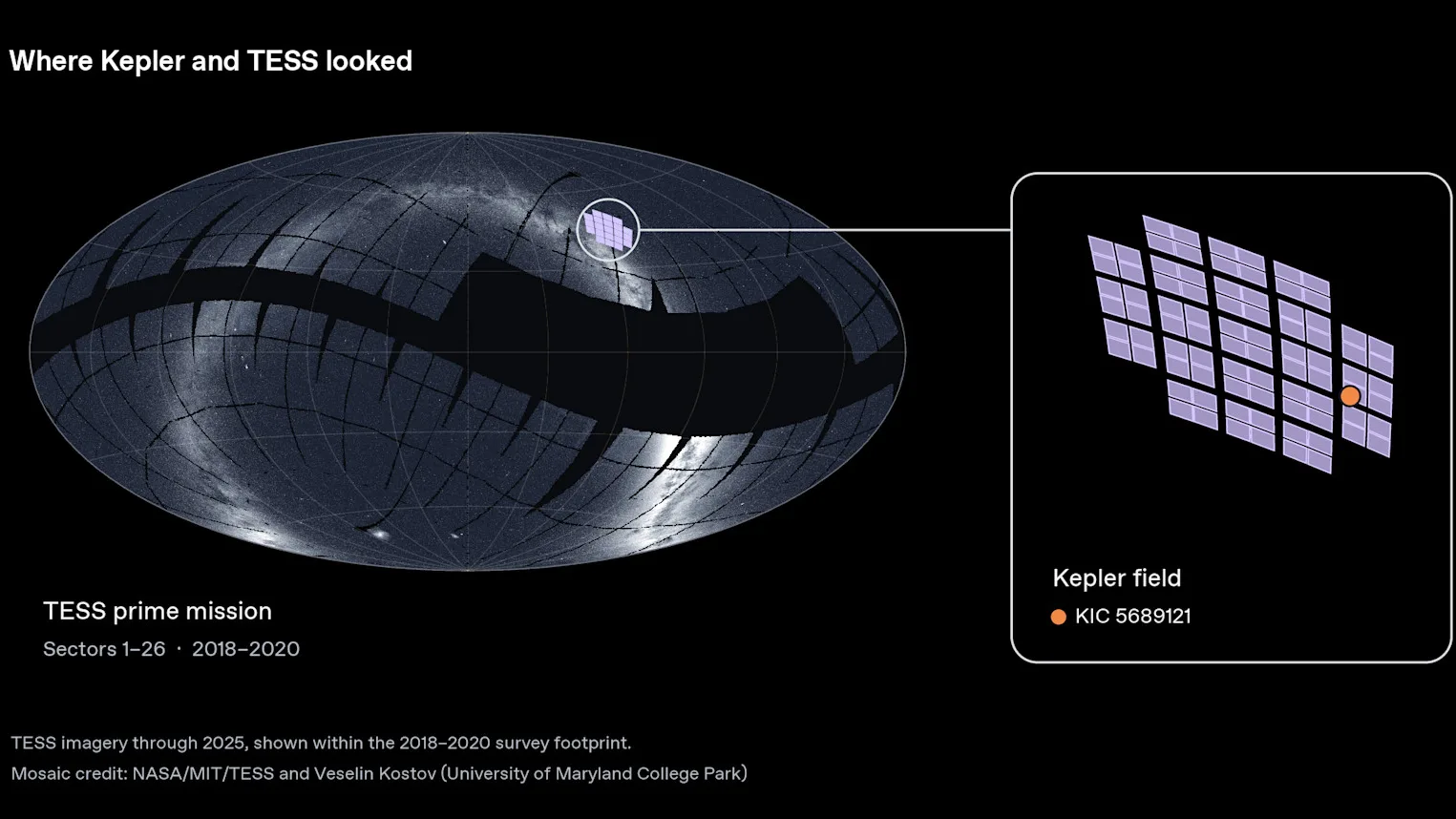
The search flagged more than 200 signals, including 10 from planets that were already confirmed, which gave Bond confidence in the method. Two stars stood out. KIC 5689121, a relatively cool star about half the Sun's size in the constellation Lyra, dips every 13.8 days. If a planet is causing the dip, the light it blocks suggests a body about 2.4 times Earth's diameter. KIC 6691030, a faint star in the northern sky, dips every 4.8 days, consistent with a planet smaller than Neptune. An astronomer at the SETI Institute ran an independent search and found the same two signals.
Astra and TESS
Ethan Byrd, founder of email infrastructure startup Primitive, tried several AI models before choosing Astra to analyze data from about 19 million stars. He asked Astra to review published methods, build the search software and run initial checks. Byrd designed two searches: one for exoplanet candidates in general, and one focused on habitable zones, the range of distances from a star where a planet with a suitable atmosphere could keep liquid water on its surface. His first pass, which drew on observations from NASA's TESS mission, launched in 2018, and other public archives, produced 49 candidates.
Byrd sent one of his strongest candidates to researchers working on TESS, where it awaits further analysis. Two more are waiting to be submitted, and the search is still running. Bond and Byrd have also turned to astronomers for independent assessments of their results.
Other causes can mimic a dip, such as two stars passing in front of each other or a temperature change inside a telescope. Astronomers check these possibilities with statistics and additional observations, sometimes using radial velocity, a method that measures tiny shifts in a star's light caused by a planet's pull. Findings are then published in peer-reviewed journals. For the two stars, confirming what is causing the dips could take months or years.
- #exoplanet
- #kepler
- #tess
- #astronomy
- #openai
This article was prepared with AI assistance and reviewed by an editor.
Comments (0)
- Be the first to comment.