Kioxia and Nvidia connect 144 SSDs to a GB200 rack for 1.1 PB of raw storage
Image: User5515 / Wikimedia Commons (CC0) · · 2 min read
In a Kioxia and Nvidia proof-of-concept, 144 SSDs attached to a GB200 rack brought total raw storage to about 1.1 petabytes.
Japanese memory maker Kioxia and US AI chip company Nvidia have shown a proof-of-concept system that connects 144 NVMe SSDs (fast solid-state storage drives) to a single Nvidia GB200 NVL72 server rack. The total raw SSD capacity reaches about 1.1 petabytes (PB).
As AI models grow, the limit for graphics processors (GPUs) that run AI workloads has become how much high-bandwidth memory (HBM) they can reach. HBM is fast memory placed right next to the GPU, and it is both expensive and hard to produce in large volumes. Kioxia's proposal is to give GPUs direct access to large pools of SSDs instead.
How the system is built
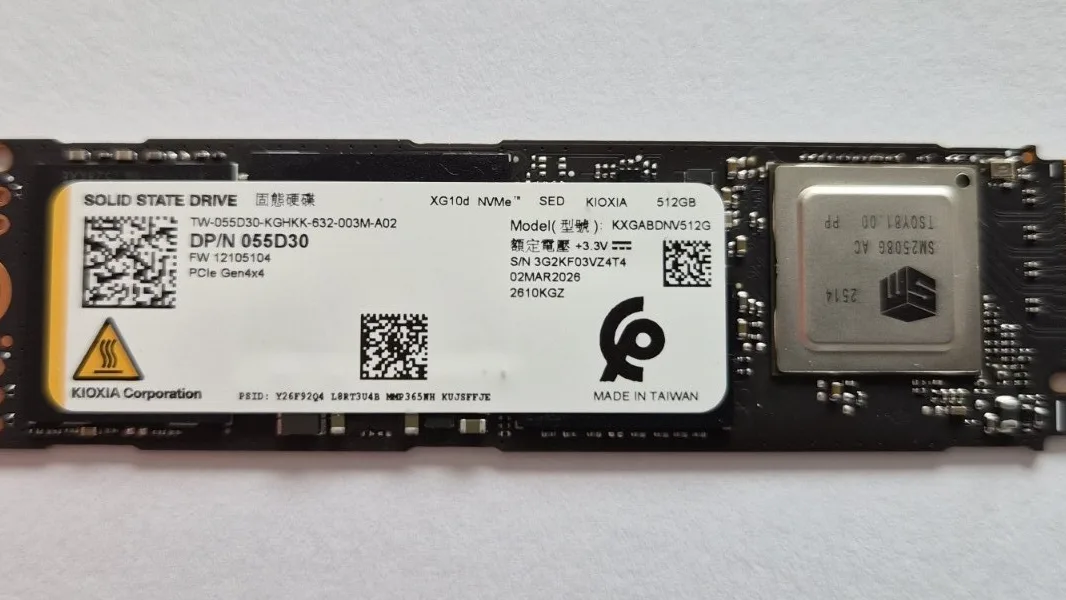
The concept uses 18 server nodes. Each node holds eight E1.S-format SSDs, giving about 60 TB of flash storage per node. The drives come from Kioxia's XD8 Series: six models from 1.9 TB to 7.68 TB, with a PCIe 5.0 interface. They support the Open Compute Project (OCP), an initiative that promotes open hardware designs for data centers.
Nvidia's SCADA software stack makes this storage usable by the GB200 GPUs. The system supports 512-byte data access, and Kioxia says the setup could potentially process 2 trillion 512-byte vectors. A vector is data represented as a list of numbers, and it is widely used in AI search and models.
Target uses include large vector databases and datasets processed with graph neural networks (GNNs), a type of model that works with data organized as connected nodes.
Goals and limits
This approach does not mean SSDs run at HBM speeds. The aim is to increase the total data capacity GPUs can reach and make large datasets easier to manage. The system is described as a proof-of-concept (PoC), a trial setup meant to show an idea works. It is still in development and testing.
Kioxia has also introduced the GP1 Series, which uses the PCIe 6.0 standard to make direct data access for GPUs more efficient. Kioxia and Nvidia continue to evaluate other options built on the SCADA software stack and the Storage-Next architecture. The company is increasingly focused on data centers and large AI infrastructure, and its memory division had earlier said that the era of cheap 1 TB consumer SSDs was over.
- #kioxia
- #nvidia
- #ssd
- #gpu
- #hbm
This article was prepared with AI assistance and reviewed by an editor.
Comments (0)
- Be the first to comment.