German startup Q.ANT builds light-based chips to cut AI energy use
Image: Q.ANT · · 2 min read
Q.ANT's photonic processors will handle nonlinear AI calculations alongside GPUs. The company says simulations show four to five times lower energy use, not yet proven in hardware.
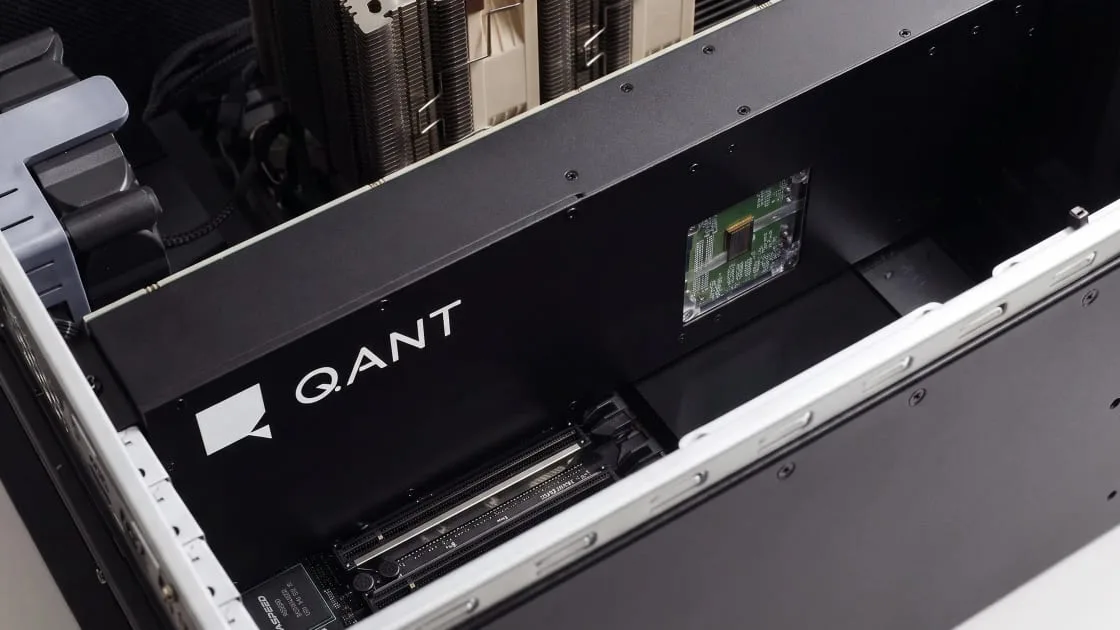
German company Q.ANT is developing photonic processors, chips that use light waves instead of electrons, to handle the most demanding calculations in AI models. The goal is to cut the energy use and the cooling costs that come with running these models. The company says the chips will not replace graphics processors (GPUs), the main hardware for AI workloads, but will run alongside them.
GPUs move and process data by shifting electrons, which generates heat along the way. Light, the company argues, produces little heat as it travels and can process more data at once. Photonic processors are meant for nonlinear, complex calculations, while GPUs are best at linear math such as large volumes of additions and multiplications.
What the founder says
Michael Förtsch, founder and CEO of Q.ANT, expects the chips to be strongest in image recognition, image segmentation, image and video generation, and in robotics and physical AI (AI that controls machines operating in the real world). He says simulations show energy use falling by four to five times, but the company has not yet demonstrated this on real hardware. Developers do not need a new programming language, since C++ and Python code can already run on the systems. Code optimized only for GPUs, however, will not speed up automatically and will need adaptation.
Förtsch describes a chicken-and-egg problem. Developers are unlikely to design for a chip that is not widely available, and cloud providers hesitate to buy chips that have few developers. Q.ANT has therefore placed proof-of-concept systems in data centers. Its chips are being rolled out to facilities of the cloud company IONOS under a pilot program, and the company says more than 30 engineering teams are developing AI models optimized for photonic computing.
Production and next steps
According to Förtsch, the chips need only 90-nanometer (nm) process technology, a mature node from the 2000s that many foundries already use for low-cost chips, so production does not require a large upfront investment. The company says it is ready to produce 100,000 units if it receives such an order, but it is unsure whether its suppliers could keep up. He adds that the hardware supply chain needs time to reach the robustness of the semiconductor industry.
Q.ANT says it is not tied to a single GPU brand and is open to working with Nvidia or AMD. Förtsch says that if an opening to take on GPUs directly appears within five years, the company would not shy away from it, but that future workloads will depend on the architecture of tomorrow's AI models.
- #fotonik
- #gpu
- #q ant
- #enerji
- #donanim
This article was prepared with AI assistance and reviewed by an editor.
Comments (0)
- Be the first to comment.