Z.ai launches GLM-5.4, a flagship that runs part of its network twice
Image: Z.ai · · 2 min read
Z.ai's flagship GLM-5.4 runs part of its network twice through a looped architecture. Performance claims for its 750B model have not been independently verified.
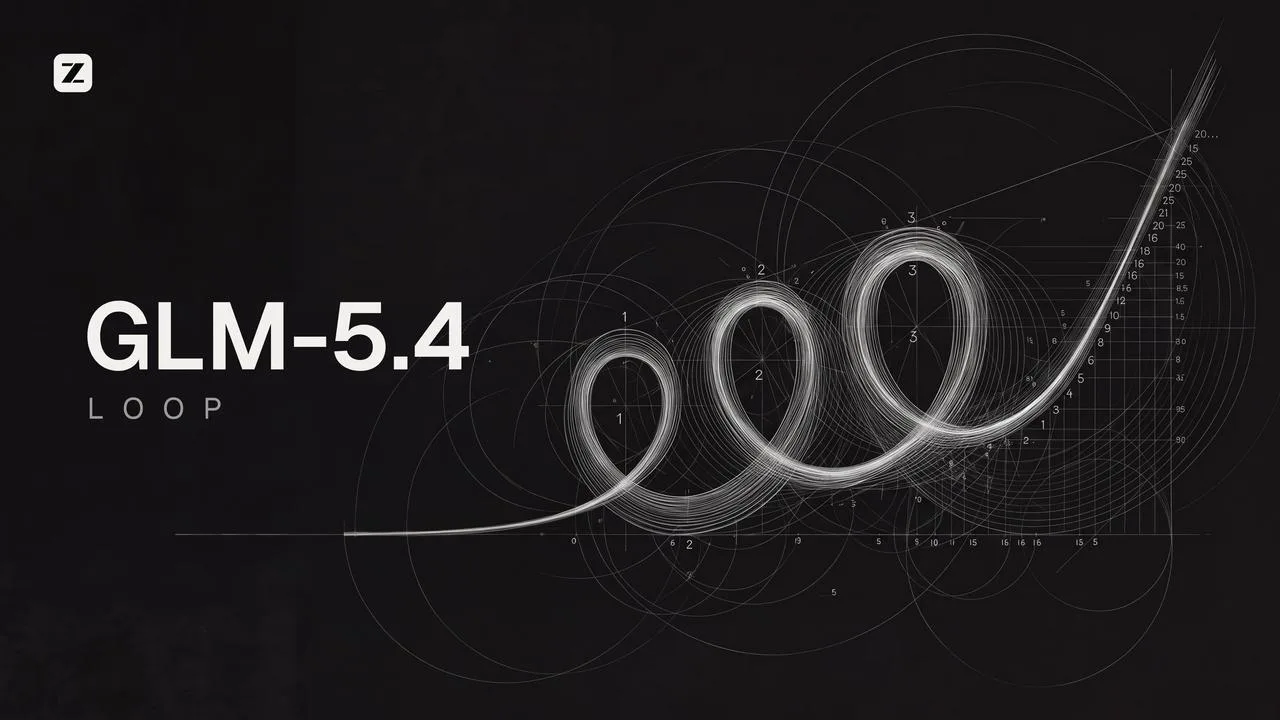
Z.ai launched GLM-5.4, its flagship model, on November 23. It is the company's first large loop transformer, a design in which some layers run twice instead of once.
Standard large language models (LLMs) pass through each layer just once per pass. In GLM-5.4, a shared block of layers runs several times, and the second pass refines the intermediate results from the first. The approach deepens the network without adding parameters. OpenAI is reported to have used a similar architecture since GPT-6 Astra.
The team converted GLM-5, its base model released in February, into this structure. Layers 27 to 54, 28 in total, now run twice. Looping creates a problem: if intermediate states are overwritten on every pass, activations grow quickly. Z.ai's fix is a gate for each token and each pass, which controls how much of the new output flows into the main data stream. According to the company, the model builds context cautiously on the first pass and writes its changes more fully on the second.
How strong are the benchmarks?
All of Z.ai's published comparisons come from a 30-billion-parameter test model. Against a standard model with the same parameter count, the looped version received about 10 percent more training compute. The largest gain is on AIME25, where the score rises from 19.2 to 30.4. GPQA-Diamond goes from 47.6 to 56.3, and AA-LCR from 40.3 to 47.7. Answers also got noticeably shorter, which the company attributes to some reasoning moving from output tokens into extra computation inside the loop.
The flagship's numbers are the missing piece. No benchmark scores have been published for the 750B model, and Z.ai's claim that it matches models with 2 to 3 trillion parameters has no independent evaluation yet. According to the company, the main weakness is overly long reasoning chains, where the model sometimes gets stuck.
Access and what comes next
For now, GLM-5.4 is available through the GLM Coding Plan, the ZCode coding environment and Z.ai Chat. The API will follow later, and no token price has been announced. Z.ai plans to release the model weights after additional safety testing.
Z.ai describes the model as the start of "Generalized Coding," where code becomes the foundation for work beyond traditional software. Its demos include a music video the model composed, a six-axis robot arm the company says was designed in FreeCAD, and interactive 3D scenes.
Why it matters: looping suggests that depth of computation can be added through repeated passes instead of more parameters. Whether that holds up in independent tests at the 750B scale is the question to watch.
- #glm 5 4
- #z ai
- #loop transformer
- #llm
This article was prepared with AI assistance and reviewed by an editor.
Comments (0)
- Be the first to comment.